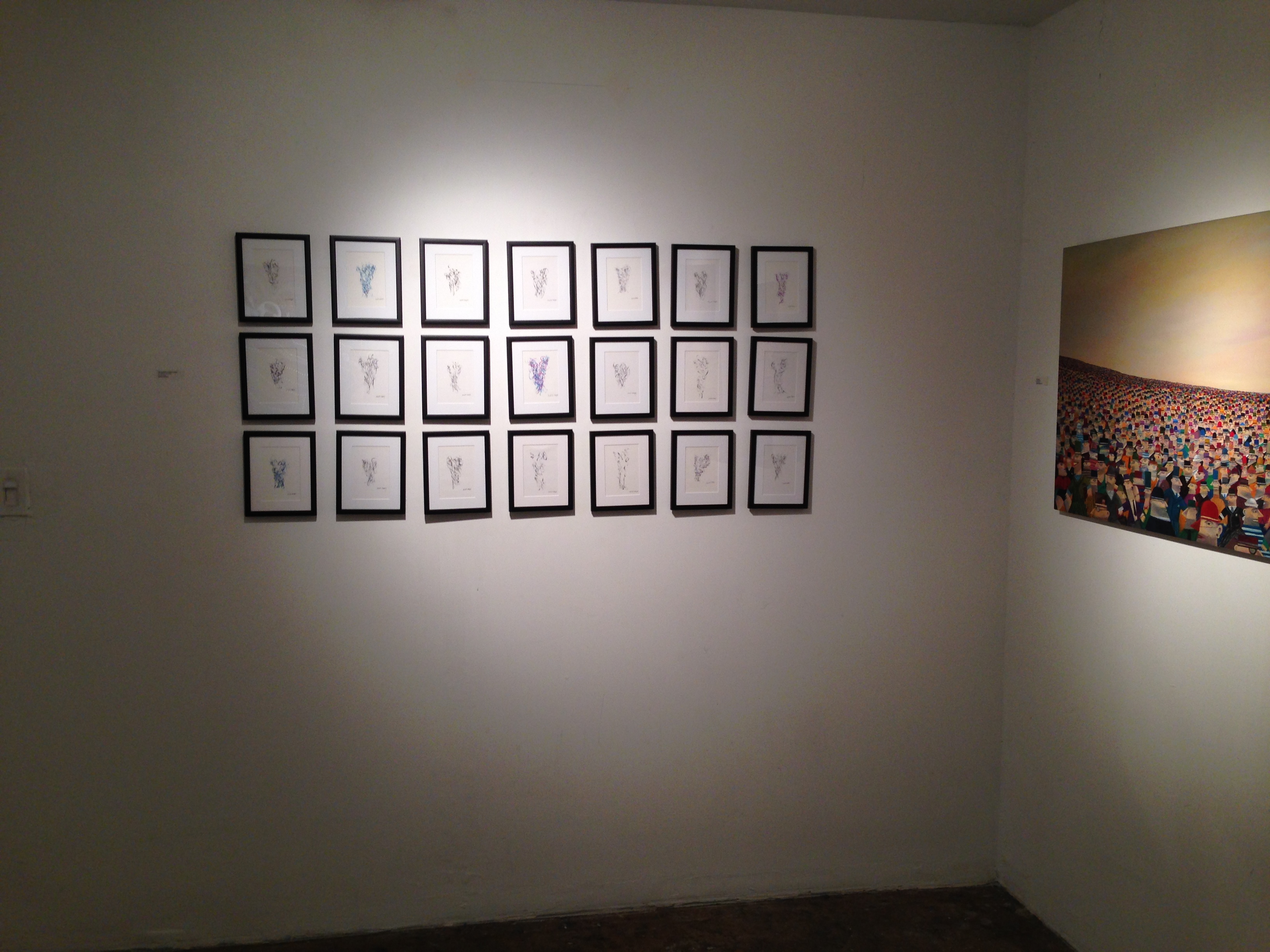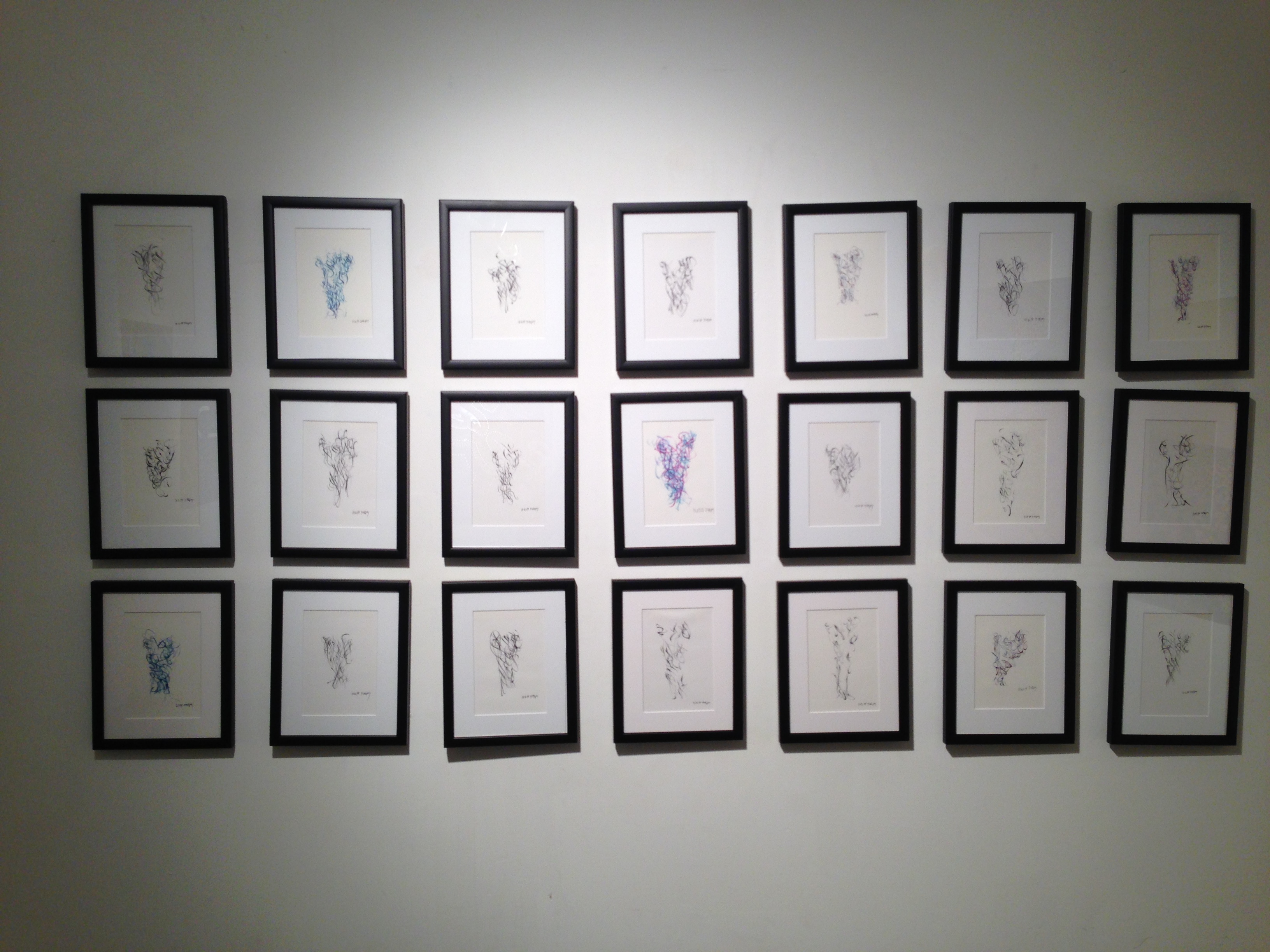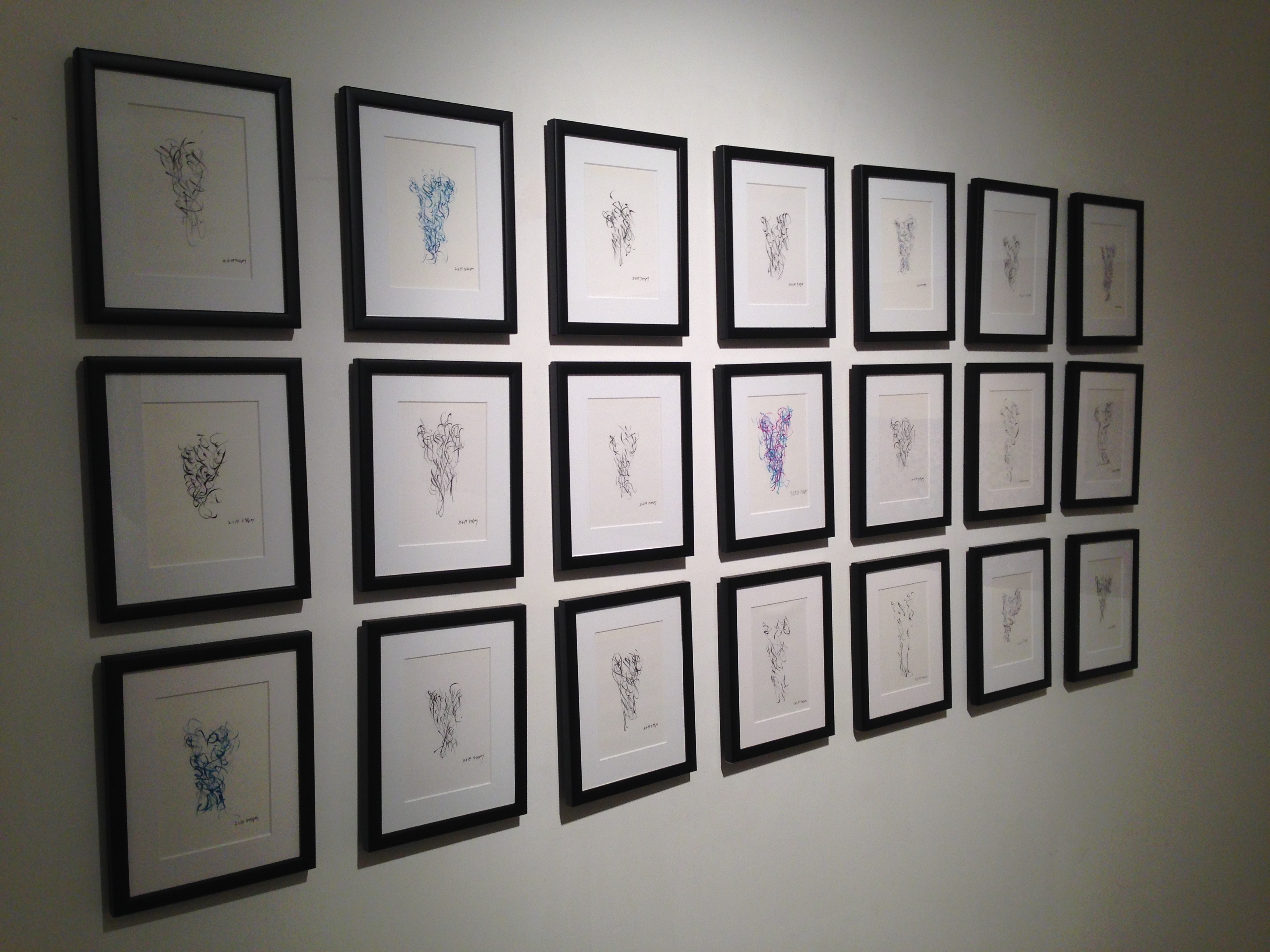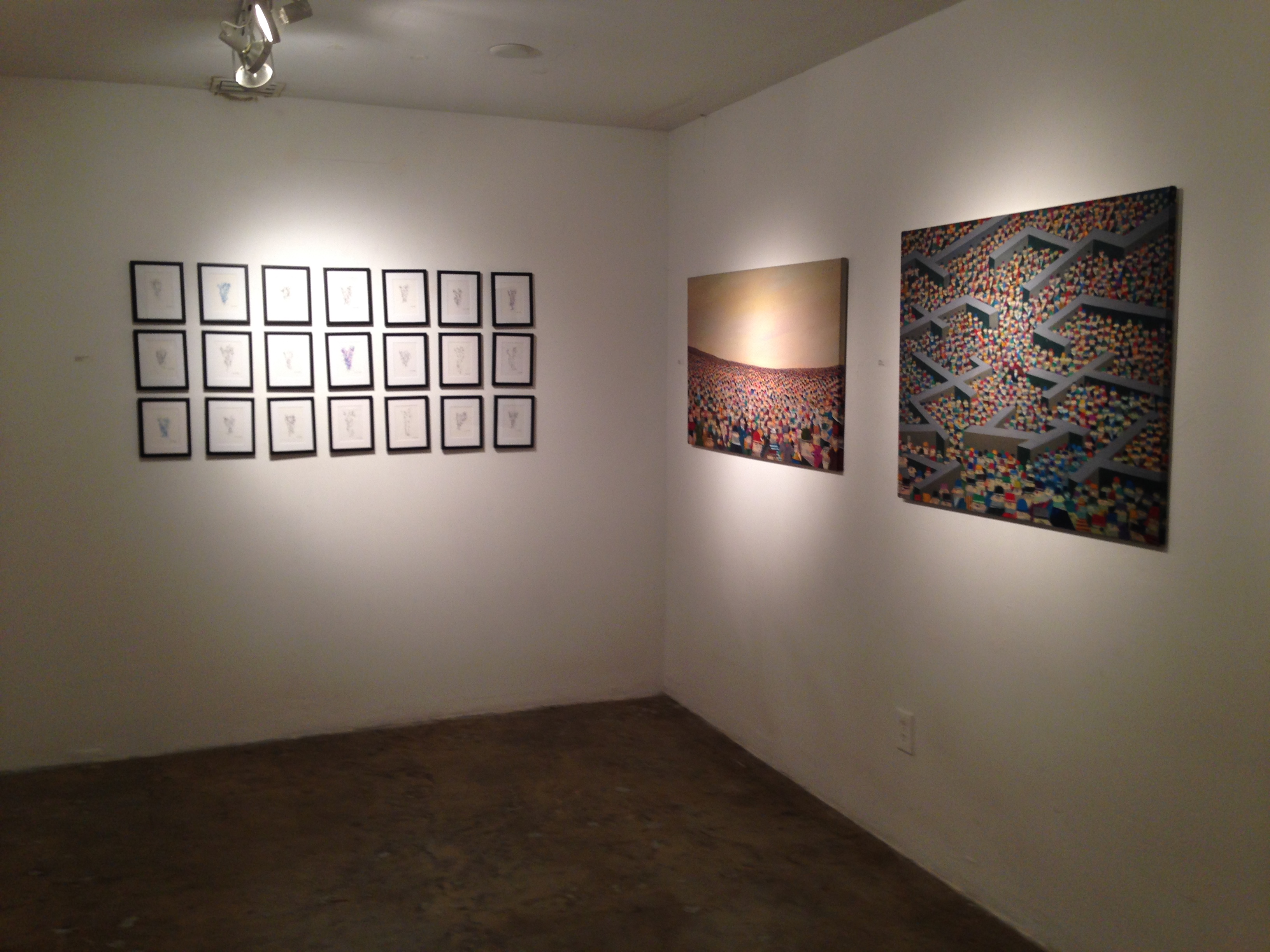

More prints

I am continuing to experiment with screen printing. Now that I have the process down I am free to make more directed experiments with colors and overlays.  I have found that 2 and 3 color variations work best.  4 and 5 colors seems to be too much for my current figures.  Here are some of my more successful two-color variations:

Dioxazine Purple and Chromium Oxide Green

Dioxazine Purple and Chromium Oxide Green


Dioxazine Purple and Turquoise (Phthalo)

Dioxazine Purple and Turquoise (Phthalo)

Turquoise (Phthalo) and Chromium Oxide Green

Turquoise (Phthalo) and Chromium Oxide Green

Three colors:

Raw Umber, Chromium Oxide Green and Napthol Red/Hansa Yellow

Raw Umber, Chromium Oxide Green and Napthol Red/Hansa Yellow

The green went down first, then the brown finally the translucent red.  Because the purple is so dark there is only an overlay effect from the red.  Either red over green or red over purple.

Raw Umber, Chromium Oxide Green and Napthol Red/Hansa Yellow (close up)

Raw Umber, Chromium Oxide Green and Napthol Red/Hansa Yellow (close up)

Raw Umber, Chromium Oxide Green, Turquoise (Phthalo)

Raw Umber, Chromium Oxide Green, Turquoise (Phthalo)

Since the turquoise went down first, there is no overlay effect at all.

Raw Umber, Chromium Oxide Green, Turquoise (Phthalo) (close up)

Raw Umber, Chromium Oxide Green, Turquoise (Phthalo) (close up)

Chromium Oxide Green, Turquoise (Phthalo) and Yellow/Green Oxide

Chromium Oxide Green, Turquoise (Phthalo) and Yellow/Green Oxide

I used two greens on this one.  The first layer was a full Chrome Oxide Green.  The oxides are all pretty opaque colors.  The Phthalo is very translucent, so there is an overlay effect on the second layer.  The third layer is a mix of Chrome Oxide Green and Yellow Oxide which is also very opaque.  This has been a favorite color mix of mine for a long time.  I like that the overlay is limited to the middle layer.

Chromium Oxide Green, Turquoise (Phthalo) and Yellow/Green Oxide (close up)

Chromium Oxide Green, Turquoise (Phthalo) and Yellow/Green Oxide (close up)

I am continuing to experiment with the technique of printing.  During this recent set of prints I started playing with the ratio of Golden Screen Print Medium to paint.  Using more than 50% medium with the heavy body paints definitely allows more transparent layers.  This does affect the fluidity of the paint mixture though and you can easily over-flood the screen with paint if you are not careful.  I found that with some of the medium to paint mixtures that I did not need to do a flood stroke.  Just pushing the ink through the screen on one pull was enough to get a clean print.

Corn Syrup and Dish Soap: cheaper and better line quality

Corn Syrup and Dish Soap: cheaper and better line quality

I read somewhere that you can make your own drawing fluid from corn syrup and dish soap.  I looked for recipes that specified how much of each but I couldn’t find anything.  So I just started mixing them.  Based on my limited experiments I can tell you I got best results when I used mostly corn syrup.  If you add too much dish soap the fluid will be too watery and it will bubble too much.  The main benefit to making your own, aside from much lower cost, is that you can control how thick it is. For the type of line work I am doing, I have found that a thicker drawing fluid produces better results.

I put a few of these up on the Prints page.  I will add more soon.


The situation in the studio right now

So I got some new toys:

Pens

The filled one is an On The Run 7mm. The replacement nips are next to it. The ArtPrimo mops are still in the bags in back.

I have been telling myself to check out refillable paint pens for awhile.  I have had not so great luck with the regular kind filled with enamel paint with the pump action nib.   I was never happy with the line quality and I found a lot of the colors would bleach out in the sun.  But a lot of companies are now making refillable ones that you can fill with whatever you want. I checked out a bunch of different places online and ended up placing an order from ArtPrimo.com who have a great selection of empty markers.  About $20 later I had an assortment of pens in 2 different sizes coming to my house. I started by just pouring the regular golden fluid acrylic in the markers.  It works enough, but the line quality improved with a few drops of water.

So this happened:

A gold variation

After each layer I added one drop of black to the pen

Raw Umber

This pen was the most fun to use. It was an 11mm nib with a super squeezy bottle. Big thick line.

Red and 2 blues

One of the more successful multi color variations.


Red, Blue and And Light Blue

The light blue is more opaque because of the titanium added. The darker blue looks almost black where it overlaps the red.

So I am definitely still playing with these.  They are capable of a very long stroke, far longer than a brush.  I am not totally in love with the line quality but that may get fixed when I get the optimal water to paint ratio figured out. Still playing with it.  I think the next will use lighter colors.  These are all about 20″ x 30″ done on a heavy paper, 90lb cotton the same as I have been using for the prints.  Here is a close up:

Close up

I may eventually get used to this line.


New Prints for 2012

So after the great reception I got for the Number 24 Prints in November, I resolved to make more prints in the new year.  Specifically new prints, not just reprints of my older work, although I probably will do a few of those too.  I originally had this plan to do crazy complex designs from a very complicated drawing, but the drawing fluid does not handle like paint and I found that the results were not optimal.  So I chose to paint new designs directly onto the screens and experiment with overlays, similar to my recent multi-linear paintings.  The even application of ink in the silkscreen process will allow overlays of color that I currently avoid in my paintings.  When painting I usually aim to apply color in opaque layers, so that each color is fully saturated in the areas I designate.  Rarely, if ever, do I allow transparent overlays.  One of the things I have noticed, particularly with some of the more transparent colors I use (specifically yellows and greens) is the difference in appearance between layers, some colors not achieving full saturation until 5 or 6 layers.  This was an element I hoped to explore in the prints.  Specifically I wanted to do several yellow-only and green-only prints to examine the more saturated overlaying sections.

As I mentioned, the drawing fluid I used for the last run of prints was good enough for the relatively thick line of Number 24.  It is the consistency of maple syrup though and does not easily make long straight lines of uniform thickness like I use in my more recent paintings.  Part of the problem is that it needs to be laid on thick in order to block out the screen filler.  A light single layer will not suffice and result in a completely filled in screen.  After several failed experiments I ended up fashioning a makeshift squeeze marker out of an old Golden fluid bottle.  It took a little practice to get used to but the results ended up looking like this:

Drawing fluid on screen

Drawing fluid on screen

After a little trial and error, and washing out the screens I didn’t like I had 5 screens drying in my hallway.

Screens drying in the hallway

Screens drying in the hallway

Drying screens

I recommend having this mess cleaned up before the spouse returns home

Then tape the corners and add the screen filler. Rinse.  Dry.  Finally ready to print.

I did several color combinations.  First 4 layers of green.  This really emphasizes the overlay effect:

4 greens

4 layers of green

4 layers of green close up

4 layers of green close up

Now with with 3 yellows:

3 yellows

3 yellows

This is definitely a more subtle overlay effect.  It is nearly impossible to see the separate layers from any distance.  Up close, however you can see changes in saturation at the overlay:

3 yellows close up

3 yellows close up

Here are some multi-color variations.  These two both have multiple layers of yellow one above and one below the first layer of green:

Yellow, green, yellow, turquoise

Yellow, green, yellow, turquoise

Yellow, green, yellow, green

Yellow, green, yellow, green

Here is one with 2 shades of green, one a full green and one a mixture of yellow and green. this is actually 1/3, one of the few where I made multiples of the same color combination:

Yellow, 2 greens

Yellow, 2 greens

2 greens, purple

2 greens, purple

Yellow, 2 greens, purple

Yellow, 2 greens, purple

For the most part these were made with Hansa Yellow Light, Phthalo Green (Yellow Shade), Turquoise (Phthalo) and Dioxazine Purple.

Check the Prints page for more.  Most of these are 1/1 with no direct duplicate. There are a few multiples too, but they are really only multiples in intent as each has a slightly unique registration.  They are not all perfect as I am still getting used to this method and making plenty of mistakes along the way, but I am learning to be okay with that.  I spent a good deal of yesterday reclaiming the screens, so the next set of prints will be all different designs.

My wall for the 12×12 exhibit at Golden Belt

Here are the 4 pieces I completed for the 12×12 exhibit at Golden Belt:

My wall from the 12x12 exhibit at Golden Belt

12x12 Exhibit

All of the work for this show had to be 12×12 inches.  I do not normally work in a square aspect so I had to get a little creative.  My first inclination was to do square drawings as these pieces are easy to adapt to different sizes.  My paintings tend to be rectangular in shape and 12 inches is smaller than most paintings I have done. In fact this size tends to be harder to complete than larger works because the complexity of my recent work does not translate well at this size.  The lines would have to be much thinner, which is difficult with the many layers I usually use.  The compromise was to crop a larger image to 12 inches square.  Several people have been asking me to do cropped images since I first posted Number 414 with the close up.  I have resisted this for several reason but mainly because I feel that the crops represent another level of editing, setting them apart from the larger set.  It’s not that they are totally other, it’s just that they represent a further subset that is not conceptually consistent with the current set.  In order for these to be consistent they would have to be several crops from the same image, so that each iteration represent the same level of editing from the initial expression.  I don’t know, maybe I am over thinking it.  The other major reason is that each figure is a complete expression, and to take part of the expression denies the wholeness of the figure.  Unless this editing is applied universally, it makes each of the iterations too distant from those occurring before an after.  Anyways, these are two experiments, and for the reasons outlined above are not numbered, merely dated.  I finished them early Thursday, December 15th before the preview of the show.

Art Basel 2011 – Day 3 in Wynwood

Ok, so I spent the day checking out some more great street art.  First up was Krave‘s beach party over at the Sunbather.  We got there early while he was still spreading the sand. This mural is awesome.  Full disclosure: I have known Dan for a long time now and consider him a good friend.  I first met him back in 2006 when I was painting Number 73 on Lincoln Road.

Dan Fila spreading sand in front of The Sunbather

After that we decided to go back to the Bakehouse and see how the old school crews were coming along:

Some old school Miami crews reuniting on the Bakehouse west wall.

The Bakehouse Arts Complex

The Bakehouse Arts Complex

I love this character @ The Bakehouse Arts Complex

While we were over there, we hit up the big wall along 95.  The front face was still mostly in progress.

131 on the 95 wall

131 on the 95 wall

The side street was going off though

As I said, going off

Dolla's wall is looking sick

In progress

This wall is killing it

Notice he is painting that with a tiny brush

Skateboarding with a cape

More murals being finished along NW 2nd Ave

Things were starting to heat up in Wynwood so we headed back to the gallery.

So there might be a lot of people out

James Brutus at GAB Studio:

James Brutus at GAB Studio

My work is at GAB Studio

The scene outside GAB studio

The portraits on the left are CPONE. Jeff Scweiger on the back wall.


Art Basel 2011 – Day 2 in Wynwood

So I haven’t  made it over to the beach yet.  Partially because I am not so interested in the big fair, partially because the traffic situation is particularly bad this year.  But I did make it to a few more corners of Wynwood and the Design District.  I saw the by now infamous Miru Kim performance/installation at Primary Projects – the one where she is living naked with two live pigs for 104 hours in a storefront window.  No pictures allowed but there are some pics over at the New Times.  Good stuff.  She does look miserable in there though.  Great Cleon Peterson painting inside too.

As per usual there is plenty of “Look at me over here!” going on.  This guy is apparently tied to some Brainwash project, also promoting a documentary (about himself) and putting up these posters:

I'm pretty sure he would be the guy who is putting up all these posters everywhere...

Glad to see that someone added the appropriate street commentary to this.  Oddly, there are no pictures of his work on this website, or on the docu website.  Just saying.

The corner of NW 40th Street and North Miami Ave

Here are some of the people I am showing with this year.


Brian Buzzella at GAB Studio:

Brian Buzzella @ GAB Studio

Jaime Adrover @ GAB Studio:

Jaime Adrover @ GAB Studio

The squatters in the empty lot next door:

These guys were from Wilmington, NC. Or at least the guy I talked to was.

Those speakers look small, but that music was very loud bouncing off the concrete walls. They painted the girl on the trailer Thursday night.  Some girl was fire eating and writhing around in her underwear on Friday.  So there was that.

Dope


This made me throw up a little.

MSG

Graffitti going up everywhere

This piece was signed COOPER

Close up of the Cooper piece

Marcello Ibanez at Multiversal:

This was my favorite piece in Multiversal

Fiftythree @ Multiversal

Buff Monster

Sergio Coyote in the Murder Lounge at Fountain:

Murder Lounge @ Fountain

More later.  Going to the Krave beach party for the Sunbather now.

Art Basel 2011 – Day 1 in Wynwood

So its Art Basel time again and I am back in Miami. As if the 14 hour drive from NC with a car full of art didn’t leave me feeling totally surreal already, every surface is covered with art.  Busy setting things up all day so I didn’t get a chance to really see much until evening.  So far: a lot of great art everywhere, amazing pop up shops, crazy people wearing crazy things, a group of squatters throwing an illegal rave in the empty lot next to the gallery, crazy, more crazy, etc. I will probably add more to this later but here are a few of the things I saw wandering around on Day 1.


Someone finally noticed

I will eat your car

Art is literally covering every available surface

Awesome

The Wall Street Maze - I will get a better picture of this during the day. Totally awesome.

The Prints are Ready

Silkscreen Printing is a technique I learned back in 1994 at Saint Paul Central High School.  I was entering 10th grade when my family moved from southwestern Minnesota to St. Paul that year.  The graduation requirements at Central (which we students referred to as CenTRO) were different from those at the school I came from.  This difference eventually allowed me to graduate early, but more on that later.  I had already taken “Art” and could not take it again for some reason when I was enrolling.  I ended up taking a class called “Graphics”.  I don’t even know if I read the description of the class, I think I just thought that it was close enough to “Art” and was better than not taking art.  This class was of course about screen printing.  That year I learned the basics of the technique and have been able to create posters and t-shirts ever since.  We learned how to hand paint designs on the screen with drawing fluid and screen filler.  If you wanted to more complex designs you cut them into rubylith film with an x-acto and photo exposed the screens on a light table. Imagine being required to bring your own knife to school in today’s security obsessed school climate.  I believe they installed metal detectors the year after I graduated.  1994 was of course a year when desktop publishing was only just becoming accessible to public schools.  That class eventually got PowerPCs (remember those?) with Adobe Illustrator (version 5 I think) but you still had to print onto regular paper and then hand cut the designs out of the rubylith.  I suspect that laser blackout film was available to the commercial screen printing industry at the time, but our teacher felt like making us work harder than that.  These skills would later come in handy when I got into adhesive vinyl as an art medium in the late 90s, but more on that later.  Honestly I wonder how I retained any of this information since I spent most of the time talking about my favorite band Big Black with the kid next to me.  That class and Ron Rogaczewski’s video class changed my life.  Thank you Centro for truly making a lasting positive contribution to my life.

I posted a notice to Facebook about 2 weeks ago asking if anyone would be interested in some silkscreen prints of one of my older paintings, Number 24 from 2006.  I got a good response so I ordered supplies and made some prints, just in time for the holidays.  Not having a good setup for photo exposure I decided to go seriously low-tech and hand paint the screens with drawing fluid and screen filler.  I felt this was appropriate since it recreates the painting process.

I feel at this time I should probably point out that I dislike the idea of digital prints.  I dislike how they are all perfectly identical and they use 4 color process to approximate actual colors.  Part of the enjoyment i receive from owning art is being able to look at it and know that the artist touched every inch of the canvas.  This object was made by someone.  I feel that in this day and age when jpgs or vector art can be transmitted around the world and printed by anyone that there is a greater significance to the experience of seeing an object that cannot be fully reproduced in such a manner.  That is why I used large paper and one of my favorite pigments Chromium Oxide Green.  This color can be simulated by the 4 color process but it will never look like the actual pigment.  This color is a rock that has been ground up and made into paint.  I like that.

I decided to make the prints at home because my studio does not have an adequate sink for rinsing the screens.   So extra special thanks to my wife Cassie for understanding that I needed to commandeer the shower for the sake of art.  Anyways for those of you are interested here is the process.

Step one, make sure you have good music:

Blasting Vitamins and Minerals by Artofficial

Blasting Vitamins and Minerals by Artofficial

I was blasting Vitamins and Minerals by Artofficial, who are good friends of mine and also a great band.  Check them out here.

The next step was to enlarge and print out the design and trace it onto the screen:

Trace onto the screen

Tracing the design onto the screen

Traced

Traced

Here are the materials I used:

supplies

Note the Pantone coffee mug - Spot color RULES

drawing fluid

Close up of the blue drawing fluid

full design in drawing fluid

full design in drawing fluid, Note the newsprint pad underneath to catch any drips

Now time to coat the screen in screen filler.  This will create the mask.  The areas with the blue drawing fluid will wash out but the red filler will remain.

screen filler

The red and blue actually looks pretty cool

After washing out the screen and drying (sorry no pictures) it was time to print.  I don’t have any photos of this because screen printing is a two handed activity and I couldn’t figure out the timer on my camera.  Anyways, you push the ink through the screen with a squeegee.  I used Golden screen print medium and Golden Heavy Body acrylic paint (Chromium Oxide Green) in a 1:1 mixture.  The paint will print well by itself but the screen printing medium keeps it from drying in the screen.  This ratio kept it wet long enough for the full run of 25 prints.  Now that I was printing there is the problem of where to dry these prints…

drying prints

Luckily we have enough square footage in the house for a print run of this size...


close up of a finsihed print

close up of a finsihed print - mmm Chrome Oxide Green


Finished Print - full view

Full view of a finished print

stack of finsihed prints

stack of finsihed prints separated by glassine paper

So the print run is done.  If any of you want one I have a few left,  You can order them here.  These are all one of a kind, because of the printing process each will have small differences in the line.  They do all look like the original though.  The final print run size is 23 plus an Artists Proof.  I had a small leakage issue on one of the pulls so one print had to be scrapped.  Each is signed and numbered by me with the date written on the back.   I trimmed the paper so the full size is 20″x30″ and it will fit in a standard poster frame of this size.  If people respond well to these I will probably print a few more of the single color “classic” designs in the future.  Feel free to let me know which ones you would want.

Further Complications

The name of the show, “Further Complications” relates to several things going on with me right now.  It describes the increased complexity of the figures in the paintings. It reflects the increased scope of work, for example the super grid.  It relates to my thinking about art this last year of isolation.  It describes the current economic realities that we are all dealing with and the uncertainty of national and global politics.  In essence the culmination of all these forces.

10.06.11 Paintings spaced ready to hang

10.06.11 Paintings spaced ready to hang

Further Complications in the Figures

People familiar with my process know that I do many sketches for each painting.  I look for the newest perfection on the form that I have been painting since 2005.  These are faces.  They are much more recognizable in my early work.  Now after more than 420 paintings many of the easy ideas have already been realized.  This is not to say that I explored all of the options as they came to light, but the direction that my interest took me led me to further and further abstraction.  The current figures are many faces overlaid on each other.  It is many feelings compressed into one experience.  This is a natural evolution in the form but is conceptually related to my belief that emotion is rarely if ever one-dimensional.  It is perfectly normal (and ordinary) to experience several emotions simultaneously.  We live in world where things interact and effect us simultaneously, why should we assume that we react to them one at a time like a gang in a Kung Fu movie.  In real life they would never line up and attack the hero one at a time, they would gang up all at once.  My intention with the paintings is for the viewer’s own state to guide which emotions they see in the painting.

Viewing

Photo by Prerna Bholah

This concept came to me one day in my old studio in the Bakehouse Art Complex.  I was working on a painting, I think it was Number 365 or 366. I was taking a break, sitting down and looking at the painting from across the room.  I had Number 328 hanging on the wall to my right by the door.  I had for whatever reason always been looking at the painting one way; orienting the face in such a way that it was facing the viewers left, with an open mouth.  When I looked over at the painting it just ‘flipped’ in my mind and suddenly it was facing towards my right with a terse, silent brooding mouth. That started me thinking that the viewers internal state affected how they saw the painting, and not just in some kind of general way but with an immediacy that could produce different interpretations for the same individual at different times.

examination

Photo by Prerna Bholah

So if each moment is different, and each drawing is the product of a moment then there will be infinite variation in the drawings.  This does not mean that there are not patterns and similarities between moments and drawings.  If things changed dramatically moment to moment there would be no order, just a cascade of confusing images.  Thus incremental and constant evolution is essential to the maintaining a coherent system.  These similarities are what map the shape of this chaotic system.

another view of the grid

Photo by Prerna Bholah

Thinking along these lines is what led me to assemble the super grid.  The desire to get more individual drawings in one place than ever before.  I wanted the experience to be immersive; surrounding the viewer so that patterns could emerge from the noise.  It was important to the concept that the drawings be in consecutive order.  I have displayed grids of drawings like this before but never at this scale, never this many pages of figures.  The final count is 48 pages, each with 165 figures for a total of 7920 figures on the whole wall.  I expected to see patterns that I did not see before.  And I did.  At this level, distinct elements of the stroke become more apparent, which leads into the next point.

18x24s left side

Photo by Prerna Bholah

The new work has taken concepts I previously developed in two new directions.  The first is color, beginning with the yellow paintings in January.  I took a constant set of colors and changed how they were used across a series of paintings.  I will come back to that in a later post though as it’s too much to include here.  The second direction, which relates to the super grid, is that I have now started separating strokes in the drawings by using multiple line colors.  This multi-linear approach draws attention to the individual parts of the iterative figuration.  Whereas in previous works the line appears as a mass, a layer, now there is depth to the line and its component parts are more easily identified.  I took this one step further in 420 and 421 by switching colors on hard directional changes in the line.  When the pen stops and abruptly changes direction this is a new stroke even if the line is not broken.  The effect is subtle in these two paintings but it will be expanded in the future.  I am still thinking about what the next project will be.

Looking

Photo by Prerna Bholah

The purple paintings are the most recent

The Supergrid

Photo by Prerna Bholah


Hanging “Further Complications” at the Durham Art Guild

10.06.11 Getting the page order straight

This is the beginning stage of the super grid. When you obsessively date and time things (like me) getting page order correct is important.  This piece required a level of planning that I had not engaged in before.  This last year I have been contemplating larger and larger projects, and not necessarily in literal terms, e.g. larger paintings (all though, yes larger paintings too).

10.06.11 The grid completed

10.06.11 The grid completed

One of the things I did not anticipate when I started this was how much I would notice the ink capacity of the pens.  I used Micron 01s – it took a whole box of 12 to finish this wall.  Each pen will only do 4 18×24 inch pages like these.  At the end of the 4th page, the pen is scraping the page, ink is still coming out but you have to press much harder and it would not complete a whole other page.  I didn’t want want to have the figures abruptly shift in opacity by changing pens mid-page so I kept to 4.  I marked each pen with a Sharpie each time I completed a page so I could pick up where I left off and not risk a pen running out mid page.

10.08.11 Grid

Another thing I did not anticipate was the physical toll this would take on my body.  I am a heavy computer user and already very familiar with carpel tunnel syndrome.  This project elevated that awareness to an entirely whole new level.  When I started in on the first page early in the morning everything was normal.  I usually sketch for an hour or so in the morning but my normal sketch books are done at a relaxed and free form state.  Uniform pages like this require intense attention to each figure.  A rhythm must build up so that a similar amount of time is spent on each drawing, otherwise figures will seem heavy from a distance.  I usually do this by listening to music.  The first couple of sessions on this wall were spent mostly listening to The Crazy World of Arthur Brown, whereas during the second half of the project I was listening mostly to Gal Costa, Erasmo Carlos and the Jorge Ben album “Africa Brasil”.

10.08.11 Grid close up

One single 18"x24" page from the Grid

But back to carpel tunnel syndrome.  At the beginning I was stretching my arm and wrist after every page.  By the 5th group of 4 pages I was stretching after every line.  Sometimes in the middle of a line.  And the effect was cumulative.  I kept myself to only a few pages at a time, usually 2 or 3 per session.  A few times I would have an early morning session and then an evening attack but for the most part it was 2-3 pages per day with a full day of rest for my hand and wrist in between.  By the last group of 4 pages, even with resting and stretching after each row my hand felt like it was going to seize up.  Within the first line my thumb would start to ache and start to lose mobility.  Ibuprofen helped the wrist but could not tackle the aching in my fingers.  Since completing the wall I have not drawn much, a few sketchbook pages here and there but I want to fully rest up my arm and decide exactly what I am going to do next.  I need to paint some more.  Painting uses a different set of muscles and does not take the same toll as drawing.  Your body aches from standing in front of of an easel all day, and your hands get tired from holding a brush but its nothing compared to the hundreds of movements in just one of these pages.